



Many neighborhood problems, like broken streetlights, poor drainage, and infrastructure gaps, go unaddressed in centralized government programs.
The Government of West Bengal launched Amader Para Amader Samadhan (APAS) to solve this.
APAS puts citizens at the center. Through para or booth-level camps, residents identify problems, prioritize solutions, and participate in planning, with ₹10 lakh allocated per booth.
This blog explains how APAS works and converts local governance.
What is Amader Para Amader Samadhan?
Amader Para Amader Samadhan (APAS) is a flagship initiative of the Government of West Bengal aimed at strengthening participatory local governance.
The program, meaning “Our Neighborhood, Our Solution,” enables citizens to identify and resolve local-level issues through community discussions held at booth or para-level camps, with government support for implementation.
Objectives of Amader Para Amader Samadhan
- Encourage active citizen participation in governance
- Identify and solve neighbourhood-level problems
- Decentralize development planning
- Ensure transparency and accountability
- Improve local infrastructure and public services
The initiative places people at the center of decision-making, ensuring development is based on real local needs.
How Amader Para Amader Samadhan Works
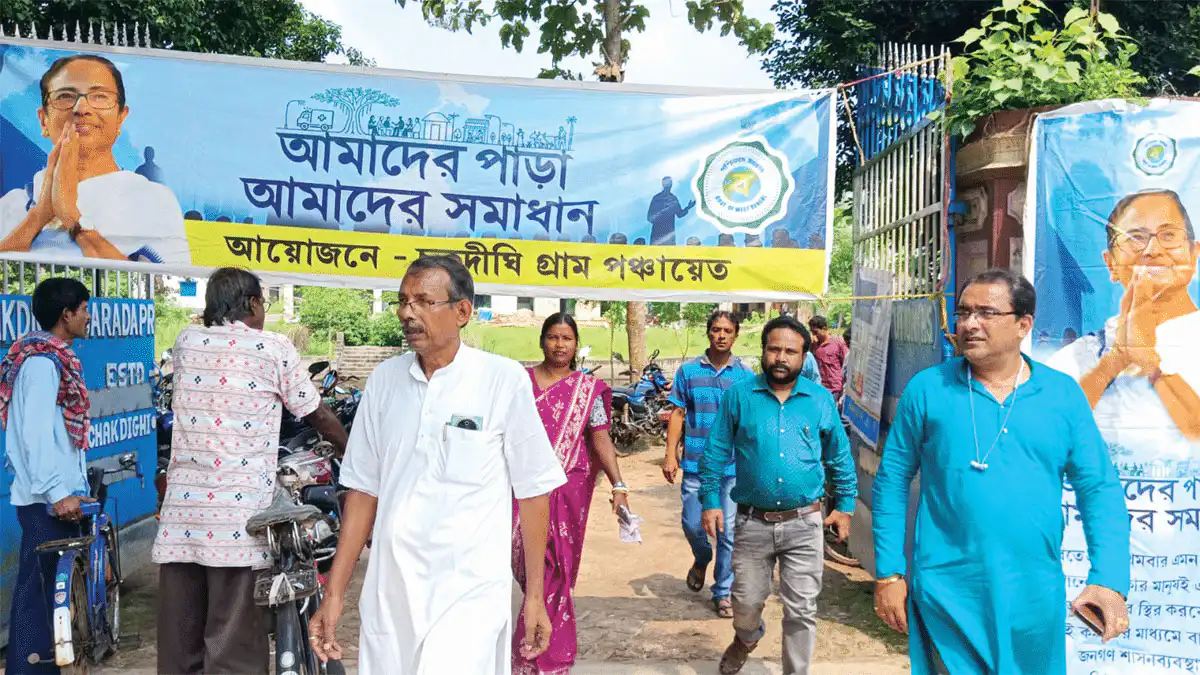
Amader Para Amader Samadhan (APAS) follows a structured, community-driven process to identify and resolve local-level issues effectively.
The initiative works through the following key steps:
1. Identification of Local Issues: Citizens identify everyday problems in their neighborhood or para, such as infrastructure, sanitation, drinking water, or public amenities.
2. APAS Camps at Booth Level: Special camps are organized where residents, local representatives, and officials come together to discuss and list priority issues.
3. Prioritization and Planning: The identified problems are collectively reviewed, and feasible development works are selected based on urgency and local needs.
4. Fund Allocation: Approved works receive dedicated financial support, with funds allocated at the booth level for implementation.
5. Execution of Works: Concerned government departments carry out the approved projects within a defined timeframe.
6. Monitoring and Accountability: Progress is monitored through reporting and audits to ensure transparency and proper use of public funds.
Through this process, APAS ensures that development is need-based, transparent, and driven by community participation.
Funding Pattern and Financial Allocation
The Amader Para Amader Samadhan (APAS) program provides ₹10 lakh per booth to address local development needs in a timely manner.
This allocation allows communities to focus on priority civic works such as roads, drainage, sanitation, drinking water, street lighting, and basic community infrastructure.
Funds are utilized by the concerned government departments as per approved plans and official guidelines.
To ensure financial discipline and transparency, expenditures are regularly reviewed, reported, and audited, making sure that resources are used efficiently for the benefit of local residents.
APAS Camps: Ground-Level Execution
- Organized at para/booth level to ensure maximum local participation
- Citizens directly raise neighbourhood issues related to civic amenities and infrastructure
- Local representatives and officials interact with residents during the camps
- Problems are recorded, discussed, and prioritized based on urgency and feasibility
- Selected issues are converted into development proposals
- Concerned departments implement approved works
- Ensures transparency, inclusion, and community-driven planning
Difference Between Amader Para Amader Samadhan and Duare Sarkar
| Aspect | Amader Para Amader Samadhan (APAS) | Duare Sarkar |
|---|---|---|
| Nature of Initiative | Community-driven development programme | Government service delivery programme |
| Primary Focus | Solving local infrastructure and civic issues | Providing welfare schemes and public services |
| Level of Operation | Para / booth level | Camp-based citizen service centers |
| Citizen Role | Active participation in identifying and prioritizing issues | Beneficiaries accessing services |
| Type of Activities | Planning and execution of development works | Application processing and service delivery |
| Outcome | Local development and infrastructure improvement | Access to government benefits and schemes |
| Objective | Participatory governance and decentralized planning | Ease of access to public services |
Monitoring, Transparency, and Accountability
The Amader Para Amader Samadhan (APAS) initiative follows a strong monitoring and accountability framework to ensure effective implementation and proper use of public funds.
- Departmental Monitoring: Concerned government departments regularly track the progress of approved works.
- Defined Guidelines: Implementation follows official Standard Operating Procedures (SOPs) to maintain uniformity and compliance.
- Financial Oversight: Fund utilization is subject to financial reviews and audits to prevent misuse.
- Reporting Mechanisms: Periodic reports are submitted to assess work status and outcomes.
- Public Accountability: Citizen participation and local-level scrutiny help ensure transparency in planning and execution.
These measures ensure that APAS remains transparent, accountable, and results-oriented at the grassroots level.
Expected Outcomes and Impact of APAS
The Amader Para Amader Samadhan (APAS) initiative is expected to bring visible improvements in neighborhood-level infrastructure and civic amenities.
By actively involving citizens in identifying and prioritizing local issues.
The program strengthens community participation and ensures that development reflects real needs.
Decentralized planning enables quicker problem resolution, while transparent implementation and regular monitoring improve accountability.
Together, these outcomes help build public trust and create a more responsive, people-centric model of local governance in West Bengal.
Conclusion
APAS represents a fundamental shift in local governance.
By placing communities at the center of decision-making, the program ensures development addresses real neighborhood needs rather than top-down assumptions.
The initiative’s strength lies in its participatory approach; citizens identify daily problems, help plan solutions, and see them implemented with dedicated funding and transparent monitoring.